


Far-right outsider advances in Colombia’s heated presidential election

By ANNIE CORREAL, GENEVIEVE GLATSKY and LUIS FERRÉ-SADURNÍ
Colombia’s heated presidential election headed to a runoff Sunday, preliminary official results showed, as a far-right candidate advanced in what could herald another gain for the right-wing wave sweeping elections across Latin America.
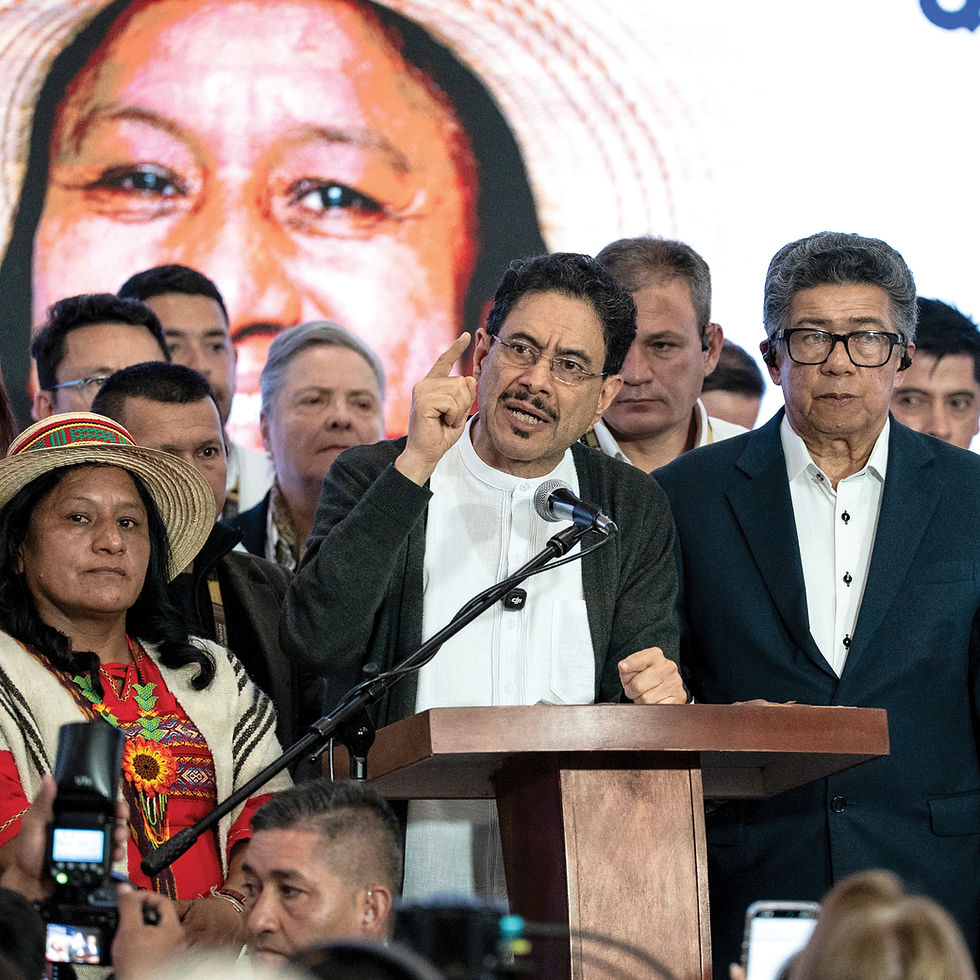
The candidate, Abelardo de la Espriella, will now face Iván Cepeda, a senator from the left-wing party of the outgoing president, Gustavo Petro.
De la Espriella, whose rise came late in the campaign, resembles a new breed of flashy populist leaders in Latin America including El Salvador’s Nayib Bukele who share President Donald Trump’s hard-line approach to crime and have pledged to apply it to drug traffickers.
With 100% of the votes counted, results released by Colombia’s national civil registry revealed an electorate split down the middle. De la Espriella received 43.74% of the vote, and Cepeda 40.90%. Because neither candidate had more than 50% of the vote, a runoff will be held June 21.
On Sunday night, Petro said that he would not accept the preliminary results until an official vote count was complete.
Cepeda, a longtime human rights advocate, managed to hang on to the broad base of support for Petro’s political project, which has sought to represent poor and disenfranchised populations long left out of the halls of power. Petro was limited to a single term.
De la Espriella’s unexpected rise derailed what the Colombian political establishment had believed would be a path to the runoff by Paloma Valencia, a conservative senator who had the support of some of the country’s most powerful politicians. Instead Valencia received just under 7% of the vote Sunday.
Experts say the results are a startling rebuke to the conservative establishment that has largely governed Colombia, a diverse South American country of 54 million people, since its independence more than 200 years ago. Petro was Colombia’s first leftist leader.
“It’s the first time ever that the country is divided between a bloc on the left and a bloc on the right,” said Maria Jimena Duzán, a prominent Colombian investigative journalist and political commentator.
Officials in Washington were expected to watch the next round of voting closely. The Trump administration has been working to advance the right-wing wave in Latin America as it seeks allies for its aggressive push against drug traffickers.
De la Espriella, 47, a lawyer who has never held office, rose in the polls in the final stretch of the campaign by pitching himself as an antiestablishment outsider and stoking fears that the left would turn Colombia into Venezuela, the failed authoritarian state next door.
He also capitalized on widespread security concerns, promising to crack down on the armed groups and gangs that many Colombians say have made extortion a fact of life. In a seeming nod to Bukele’s prison system in El Salvador, de la Espriella pledged to build 10 maximum-security prisons in the jungle.
Cepeda, 63, is a staunch ally of Petro’s who ran on a platform of continuity and a promise to defend victims of the country’s armed conflicts, as well as the poor. While experts say Cepeda benefited from the left’s strong base — and a recent, sizable increase to the minimum wage — it was not clear if his reserved personality and policy-focused speeches would appeal to voters the way Petro’s galvanizing presence did.
“Petro paved the way for someone who isn’t charismatic like him, but who is more substantive,” said Eduardo Ayala, a political scientist who attended a rally for Cepeda in the capital, Bogotá.
Many of de la Espriella’s supporters echoed their candidate’s claim that Cepeda would be more radical than Petro. “It would be a disaster,” said Klaudia Rincón, an eighth grade math teacher from Barranquilla, the coastal Caribbean city where De la Espriella cast his vote, as she headed to the polls. “Total communism.”
Voters, commenters and analysts agreed that the election had been like no other in living memory.
De la Espriella’s campaign combined old-fashioned populism with new stunts including artificial intelligence-generated videos realistically depicting his political rivals plotting against him. To get around a rule against wearing campaign garb to the polls, his supporters were told to wear the canary-yellow jersey of Colombia’s national soccer team.
Many voters said Sunday that despite de la Espriella’s bombast, they were reassured by his running mate, José Manuel Restrepo, a seasoned economist who was finance minister under a previous conservative president, Iván Duque.
The right’s vote, which was split between de la Espriella and Valencia, could coalesce around the far-right candidate in the second round. Experts said centrist voters might move toward the left in the runoff, but that Cepeda would need to assure them that he would not move to nationalize industries or otherwise adopt far-left measures that would affect the economy.
He has an uphill battle, not only because of anti-left sentiment but because of disappointment in many quarters with Petro, whose term was marked by personal and government scandals and runaway spending that left a debt of pandemic-era levels, economists said.
In de la Espriella, he faces a flashy figure who captivated a broad following with virtuosic speeches delivered from a bulletproof box, a tiger mascot and a catchy slogan of “Firme por la Patria!” (“Standing Strong for the Homeland!”)
For many voters, the spectacle seemed to eclipse his lack of experience.
“He looks like an intelligent guy,” said Silvia Garcia, a retired interpreter who voted for the candidate in Barranquilla, predicting he would build a strong Cabinet.
Many voters appeared to overlook de la Espriella’s links to notorious Colombian clients such as Alex Saab, a close ally of Venezuela’s former leader, who has been extradited to the United States.
“It’s like a doctor treating a criminal, a guerrilla or a paramilitary,” a voter in Bogotá, Fabián Campos, said of de la Espriella’s legal career. “If it’s your job, you provide the service.”
Turnout was high on Election Day, and international observers said there had been no major problems despite predictions of fraud on both sides, and threats and violent attacks on the campaign trail, including the fatal shooting of two de la Espriella campaign workers.
Esteban González Pons, head of the European Union’s election observation mission in Colombia, called the electoral process “orderly, calm, transparent and fluid.”
Turnout was high among Colombians living abroad, with the majority of voters in the United States voting for de la Espriella, results showed. In Miami-Dade County, Florida, voters had lined up starting days ago outside the consulate, many wearing yellow jerseys and shouting his campaign slogans.
In many ways, the vote was a referendum on the legacy of the departing president. His term was defined by the historic representation of Indigenous, Afro-Colombian and LGBTQ+ communities, but also by a stalled legislative agenda, digressive public speeches and a rocky relationship with Trump.


Comments