How a progressive Democrat in Florida gave her party new hope — and new fears

By PATRICIA MAZZEI
Florida, of all places, just became the stage where Democrats will act out their national existential drama dividing the insurgent left and pragmatic center.
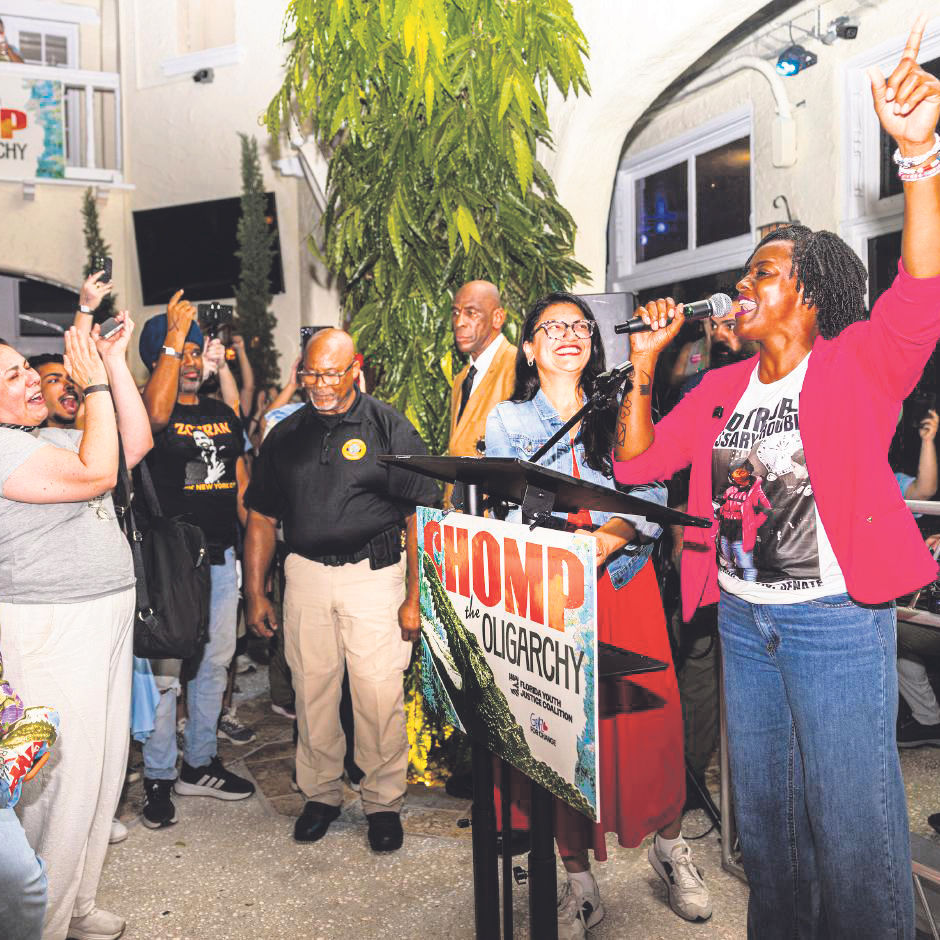
Progressive maverick Angie Nixon’s upset win in the Democratic Senate primary last week jolted Florida politics, reshaping the dynamics of what had appeared to be a predictable race into one fraught with uncertainty — and, perhaps, opportunity.
Democrats, who have struggled for relevance over the past few election cycles in the state, were torn by a familiar mix of fear and excitement. Would Nixon’s unexpected nomination hurt the party’s centrist nominee for governor, David Jolly, a former Republican? Or would it bring a sudden shock of energy that the party had not experienced in nearly a decade?
“‘Can you both win on the same ballot?’” Jolly said in an interview Thursday, repeating what many have asked him since the primary Tuesday. “I don’t know. I mean, this is fascinating.”
The tug of war between Democratic moderates and increasingly left-wing progressives has defined this year’s midterm primary elections across the country. Candidates from the party’s left flank and democratic socialists have notched significant victories in blue and purple states. Few had predicted that red Florida would display that tension in its top-of-the-ticket races.
Republicans seized on Nixon’s relatively new affiliation with the Democratic Socialists of America to cast every down-ballot Democrat as out of touch in a state that has leaned more and more toward the right over the past decade. The GOP remains favored to win statewide races: Registered Republicans outnumber Democrats by 1.5 million in Florida, and President Donald Trump won the state by 13 percentage points in 2024.
“If I told you last year that Florida would have a nominee to the United States Senate that was a self-declared socialist, would you believe me?” Sen. Ashley Moody, the Republican incumbent, said at rally in Tampa on Thursday. “Not a joke!”
Attacks like that have forced Nixon and Jolly to spend much of their time since Tuesday on defense, doing television interviews to push back against the socialist label, which has proved especially difficult for Democrats to fend off in South Florida, home to many Latin Americans who fled left-wing governments.
Nixon, a state representative from Jacksonville, has been an unabashed progressive in Florida politics for the past decade, which is how most Democratic voters know her. She joined the DSA only in June. The group did not endorse her, and their positions do not neatly align.
“I’m a capitalist who believes that we need some strong regulations,” Nixon told NBC’s “Meet the Press NOW” on Thursday. Moody, she added, “knows that I’m not a socialist.”
Nixon’s primary opponent, Alex Vindman, a former national security official, lost in the heavily Democratic Broward County, where he lives, though he won in neighboring Palm Beach County. Both counties have high concentrations of Jewish voters, who have been trending away from the Democratic Party as it has grown more progressive.
Nixon did not run a campaign centered on Israel or foreign policy, but she supported a ceasefire in the Gaza Strip and publicly called out Palestinian deaths. Whether she will win over Jewish Democrats who backed Vindman remains in question.
“Her outreach to the Jewish community has not been good,” Richard Stark, a former state lawmaker and member of the Florida Democratic Party Jewish Caucus who supported Vindman, said at Vindman’s campaign event Tuesday night.
Vindman’s supporters and his campaign were stunned by Nixon’s 12-percentage-point victory. Campaign finance reports show that the campaign paid two pollsters. The campaign never released internal polls, but it appeared clear that they had thought Vindman was ahead because he never took on Nixon more directly. Instead, he mostly ignored her.
Longtime Democratic activists credited Nixon with campaigning across the state, even if it meant showing up to what Jolly called “chicken lunches” with 15 or 20 party stalwarts. Often, Jolly said, he and Nixon were the only candidates in attendance.
Nixon and Jolly are friendly, despite their policy differences. Democratic activists see potential advantages to their unlikely partnership, including the ability to appeal to different portions of the electorate to broaden support for the ticket.
Nixon has also proved herself to be a formidable organizer who knows how to gin up excitement among voters. The last Democratic candidates who were able to generate much enthusiasm in Florida were also Black: Andrew Gillum, who almost won the 2018 governor’s race, and Barack Obama, who won Florida in the 2008 and 2012 presidential elections.
Nixon’s victory has led to some friction inside the party.
Nikki Fried, the party chair, did not call Nixon until Friday, three days after the election. A unity rally that had been planned for Saturday near Orlando, when Vindman was the expected Senate nominee, was scrapped after Nixon won, in part because she had not been aware of the rally beforehand and the date did not work for her. Some Democratic activists had perceived that the party showed favoritism toward Vindman during the primary campaign, which it denied.
In an interview Friday, Fried was circumspect about Nixon’s win.
“It’s going to be an interesting dynamic,” she said of having Nixon and Jolly atop the ticket. “The voters are looking for fighters. They want to know that someone hears them.”
Eunic Epstein-Ortiz, Nixon’s campaign manager, said in a statement that the nominee had heard from leaders across the state and country supporting her after her win.
“Right now, the Angie Nixon campaign for U.S. Senate is solely focused on continuing their 67-county strategy needed to defeat Ashley Moody this November,” Epstein-Ortiz said.
Nixon’s campaign said it raised $1 million in the first 48 hours after her win — more than she had raised in the entire primary — though that was still far less than the $8 million that Moody has in the bank.
On Thursday, Nixon received the endorsement of Sen. Bernie Sanders, the Vermont independent and democratic socialist whose presidential campaign she worked on in 2016. Sanders joined Nixon and Rep. Maxwell Alejandro Frost, a progressive from Orlando, on a call Thursday night with 1,200 people, according to her campaign. The campaign said some 40,000 people have signed up to volunteer for Nixon.
“Her and David make such a great ticket,” Frost, who had endorsed both candidates before the primary, said in an interview. “It showcases and resembles our big tent as Florida Democrats.”