In a major boost for the right, another Bolsonaro nears Brazil’s presidency

By ANA IONOVA and ADAM B. ELLICK
A surprise victory for a right-wing populist embroiled in scandal. Crushing defeat for a party deemed out of touch with its base. Supporters on the left grasping for answers.
The scene may feel familiar to Americans. This time, it unfolded in a Latin American nation thousands of miles away. And the results could profoundly reshape the region and its relations with Washington.
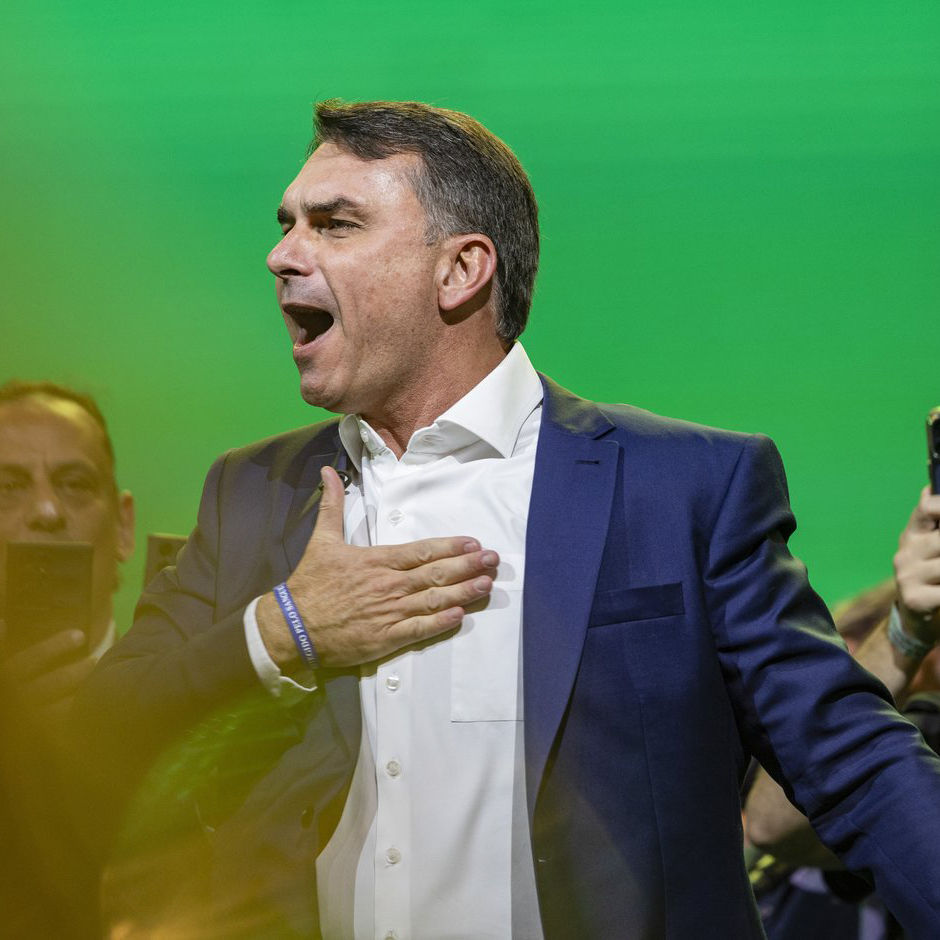
Brazil’s right-wing challenger, Flávio Bolsonaro, didn’t win the presidency in Sunday’s election, but seemed well on his way to victory.
His surprisingly strong showing gives a significant boost to the ascendant right in Latin America, placing Brazil, the region’s most populous country, within reach as the biggest electoral prize following seven wins by right-wing candidates.
It also represents a remarkable comeback for the Bolsonaro family four years after Bolsonaro’s father, Jair Bolsonaro, tried to subvert democracy after losing the last election, was convicted of plotting a coup and sentenced to prison.
Flávio Bolsonaro himself overcame being embroiled in a corruption scandal to win more votes than the leftist incumbent, President Luiz Inácio Lula da Silva.
While neither clinched enough ballots to win in the first round of voting, Bolsonaro’s formidable performance appeared to foreshadow a win in a two-way contest on Oct. 25.
That is because the votes of some 9 million Brazilians who backed various minor right-wing candidates Sunday will now be up for grabs. The vast majority are likely to shift their support to Bolsonaro, giving him the upper hand. For Lula, finding more votes presents a far more challenging task.
The regional swing to the right is driven by an array of forces, experts say, including dissatisfaction with incumbent governments, deepening worries about security and crime, and a shift toward more conservative values.
For months, polls had predicted a close race between the two men, with Lula leading by the slimmest of margins. The leftist president had framed his candidacy as the only way to halt the return of the Bolsonaro family to power after Jair Bolsonaro inspired his supporters to storm the capital after his loss, demanding that the result be overturned.
Lula had also sought to portray his candidacy as defending Brazil’s sovereignty against attempts by the Trump administration to intervene in the country’s domestic affairs.
Flávio Bolsonaro had struggled to shake off a corruption investigation and divided voters with his plans to seek amnesty for his father and the rioters. Then, on Sunday, he surprised many when he captured 47% of the vote, finishing 2 points ahead of his rival.
“Even Jair Bolsonaro may be surprised by this result,” said Jairo Nicolau, a prominent political scientist and professor at the Getúlio Vargas Foundation, a research institution.
A win for Flávio Bolsonaro in the runoff later this month would represent a major triumph for President Donald Trump, ejecting Lula, one of his most outspoken foes among world leaders, who has not shied away from challenging the American leader.
It would also usher in an enthusiastic ally willing to help Trump’s bold plans for dominance in the region.
A surprise favorite
It is not yet clear just what brought Bolsonaro to the brink of victory.
“It was conceivable that Flávio could come close to Lula or even overtake him,” Nicolau said. “But what happened in Brazil was a right-wing tidal wave,” he added. “We’re going to spend a long time trying to understand.”
What unfolded in Brazil may have echoed a challenge incumbents face across the region: persuading voters to give them more time to deliver on pledges.
“Basically, it’s never a good thing to be president in South America,” said Guilherme Casarões, professor of Brazilian studies at Florida International University in Miami. Governments on the left and the right have struggled to win second consecutive terms in the region.
Some analysts said they believed Bolsonaro had managed to rally at least a slice of conservative voters who had planned to vote for other right-wing contenders. Disillusionment with Lula’s party, which has been in power for the better part of two decades, also most likely fueled his challenger’s success.
Many Brazilians are concerned over pervasive violence and crushing personal debt.
Bolsonaro has tried to link his rival to a corruption scandal sweeping Brazil’s Supreme Court. Lula has tried to distance himself and called for a judicial overhaul.
The momentum of the Brazilian right was also on full display in the nation’s legislative races, where right-wing candidates, including four other members of the Bolsonaro family, made spectacular strides in both Congress and the Senate.
“A complete takeover of the far right,” Casarões said.
This means that, whomever ultimately wins the presidency, Latin America’s largest democracy is poised to keep marching to the right.
The prospect excited Carlos Augusto Marques, a 63-year-old writer voting Sunday in Rio de Janeiro. “To improve, we need four or five center-right governments, at least,” he said.
If Bolsonaro wins, his party’s gains could allow him to deliver some of his most polarizing promises: an amnesty for his father, pardons for participants of the Jan. 8, 2023, riots and a Senate more willing to try to remove justices who convicted his father.
A pathway to victory
Now, the presidential contest is headed for what is likely to be a bitterly contested final leg, with both candidates racing to capture millions more votes. Yet the pathway to victory may prove far more daunting for Lula.
Analysts said he could still stage a comeback, particularly if he could win over some of the 33 million Brazilians who skipped Sunday’s vote.
In Brazil, voting is mandatory for most people from the ages of 18 to 70, though absentees face only a small fine. This year, the number of Brazilians who sat out the first round rose to a record high of 21%.
Lula may also succeed in striking coalitions with other parties in hopes of persuading some moderate voters who reject Bolsonaro to shift their support to him.
Alberto Saab, 55, an engineer, is among the 8% of voters on Sunday who supported a third-party candidate. He has voted for both candidates in the past, but remains undecided so far for the runoff.
He has been impressed with leftist investment in education, yet he also supports the right’s bolder measures on security. “The world is very polarized,” he said. “If we don’t return to some sort of center of balance, I think we’ll remain in a difficult situation.”
Bolsonaro is being investigated after raising millions for a biopic about his jailed father from a disgraced banker at the center of a huge fraud case. Details of the investigation have dominated public debate, fueling expectations for more bombshell revelations closer to the final vote.
In recent weeks, Lula has seized the opportunity to dial up attacks on his rival’s record. His campaign aired a short documentary online exploring controversies in Bolsonaro’s political career and a video on Bolsonaro’s alleged ties to militias. Some voters may not be swayed in either direction. Kailhany Machado, 23, voted for a third candidate and plans to cast a blank ballot in the runoff.
“Flávio is involved in several scandals and Lula? I don’t even need to tell you,” Machado said. “They’re corrupt, criminal and don’t deserve our vote.”
Enter Trump?
Trump has been a wild card in Brazil’s presidential race.
Before the runoff, he could stay quiet, openly endorse Bolsonaro or ratchet up pressure with new measures aimed at Brazil.
Last year, Trump stepped in to help Bolsonaro’s father avoid a prison term. Nevertheless, the elder Bolsonaro was sentenced to 27 years in prison, though he is serving his term at home because of poor health.
Trump has not championed any presidential candidate, though his administration has appeared to lift Flávio Bolsonaro in more subtle ways before the vote. This has alarmed Brazil, which has accused the United States of trying to sway its elections and has put up a firewall to try to shield its democracy from threats.
Bolsonaro has aligned himself with Trump and other right-wing leaders in the region, echoing plans to mount a hard-line attack on the drug gangs that have become a major concern for many ordinary Brazilians.
And, like Trump, Bolsonaro is now looking to rewrite his own nation’s history.