


Mamdani’s surprisingly persuasive solution to a world on fire

By LYDIA POLGREEN
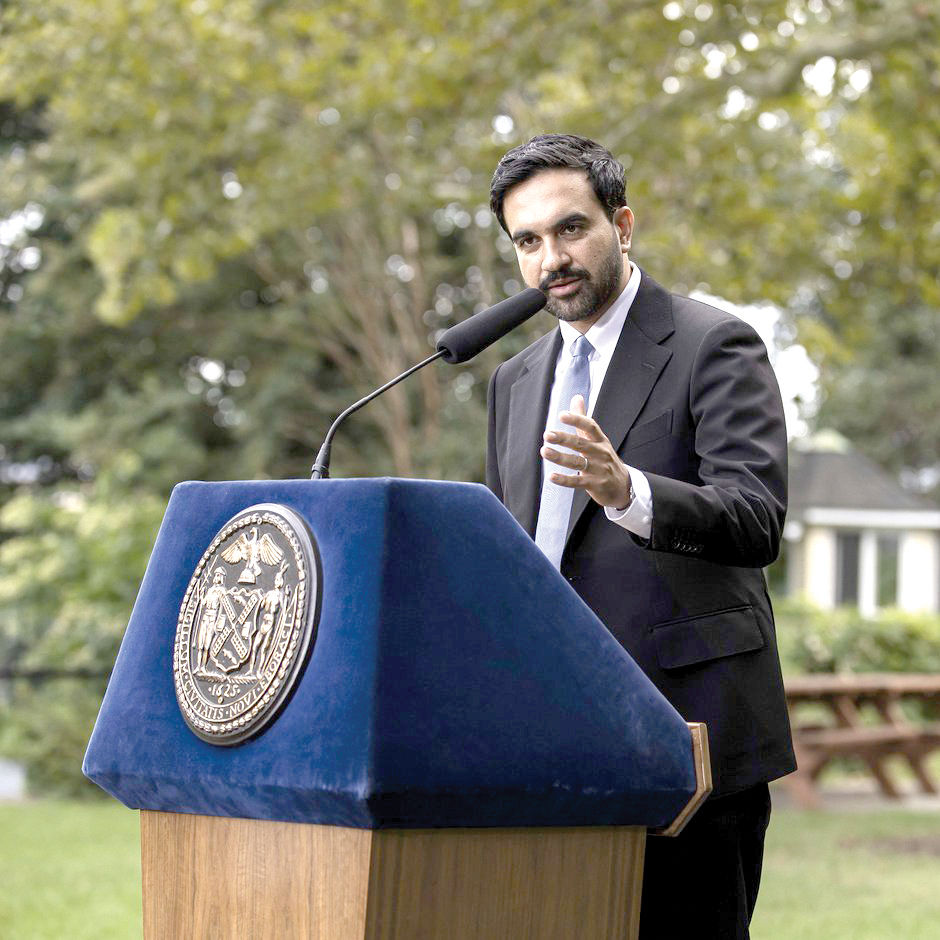
A few days before the leaders of the world streamed into the cavernous, marble-lined General Assembly Hall to deliver their speeches on the grave crises convulsing our combustible world, New York City Mayor Zohran Mamdani offered his own, somewhat surprising solution to the problem of rising authoritarianism: filling potholes.
“If politics cannot deliver on the block where you live, why would you trust it to deliver anywhere?” Mamdani asked a gathering of mayors from big cities across the world, explaining his obsession with potholes, more than 200,000 of which have been filled across the city since he took office. “If you are making a New Yorker’s life a little smoother, so too you are making their journey to believe in government’s ability to deliver for them.”
It is commonplace to lament the ineffectual talking shop that the United Nations General Assembly has become, with its blustering speeches and endless unread communiqués. Wars of aggression are raging in Ukraine and Iran; Israel has carried out a genocide in the Gaza Strip; climate catastrophes impoverish and kill. In the face of these calamities, the organization appears powerless.
Today, the body’s soaring aims — to create a more peaceful, humane world that respects the sovereignty of each nation and the dignity of each human being — seem like a fantasy from another dimension. Citizens the world over are dissatisfied with their governments and in many places are souring on democracy itself. Can it be any surprise that this supranational body comes in for such contempt?
And yet Mamdani sensed an opportunity to reclaim some of its founding spirit. Racing across the city, he seemed to be offering an antidote to globe-spanning distemper. To restore faith in institutions, you must begin from the bottom up, starting with things as simple as potholes. Politics, as he put it, “has to translate to the pavement.”
New York City has long held a singular spot on the international stage, and its mayors have become global figures. But Mamdani, by dint of his youth, his improbable rise and his unusual background, brings a vivid symbolism to the role. African by birth, South Asian by heritage, American by choice, Mamdani in many ways embodies the cosmopolitan ideal at the heart of the United Nations’ founding.
World leaders lined up to spend time with him. He went to Queens with Ireland’s prime minister for a bingo game at an Irish American community center. He met with Brazil’s octogenarian leftist president and breakfasted with Spain’s dashing left-wing prime minister. Norway’s prime minister tagged along with him to visit a New York City classroom and talk about artificial intelligence in education.
Even President Donald Trump couldn’t resist some time with the mayor. Last month, he dropped by Gracie Mansion, spending about an hour behind closed doors with Mamdani — an eternity in presidential scheduling. Trump seemed in no rush to leave as the two took questions from reporters, beaming as he declared, “I want him to be a great mayor, and he’s certainly got potential, got great potential.”
Mamdani’s agenda, as befits a mayor, was mostly municipal. He visited a wastewater treatment facility with his counterparts from Helsinki, Rome and Barcelona; welcomed families moving into public housing with the mayors of Paris, Amsterdam and Greater Manchester; and handed out flyers to delivery workers explaining their rights with Mexico City’s mayor.
When he wasn’t hanging out with his fellow mayors, he celebrated the city’s victory in court against the delivery service DoorDash, wresting over $131 million from the company in a settlement for underpaying or not paying its workers. He also announced a new initiative to give out 70,000 free tickets to the Metropolitan Opera House, part of his push to make the city’s most exclusive cultural offerings accessible to everyday New Yorkers.
Mamdani’s many critics have tried to portray him as fixated on distant hobbyhorses, like arresting Israeli Prime Minister Benjamin Netanyahu for war crimes in Gaza. But if anything, it was Netanyahu who seemed obsessed with the mayor. In his thundering speech at the United Nations last month, he called Mamdani an antisemite with “Hamas buddies.” He darkly name-checked leftist streamer Hasan Piker and even castigated Mamdani’s wife for her likes on social media.
When I caught up with Mamdani by phone, I asked him what he had hoped to get out of his first General Assembly. “We are a city that is home to hundreds of nationalities and even more languages,” Mamdani told me. “If any city is an illustration of what the United Nations principles hope to achieve, it is ours.”
But no matter how admirable those principles, the weakness of institutions like the United Nations in the face of the world’s spiraling chaos is an invitation to ask deeper questions, Mamdani said: “In a moment of a rising far right and the questioning of institutions that have otherwise been durable over many decades, it is also an opportunity to rethink what has been at the heart of those institutions, and the question of who they can serve and who they seek to serve.”
Mamdani will never be president of the United States — the Constitution forbids the office to those not born in America. For Mamdani, this may be a blessing. The minute the midterms are over, the news media and the political world will shift their focus to the 2028 presidential race, as if the most important political question on earth is who will replace Trump.
But Mamdani seems to be asking a different question: How can we renew faith in politics and close the gap between citizens and their representatives? The answer, he suggests, lies in the city itself. If cities gave birth to democracy, perhaps they are the best place to midwife its rebirth. After all, more than half the world’s population lives in urban areas, and if current trends hold, by 2050 that figure will rise to almost 70%.
That’s a lot of trust to build — and a lot of potholes to fill.


