


Mexico City protests go on without disrupting the World Cup opening ceremony

By MARIA ABI-HABIB, DAVID SHORTELL, CYNTIA BARRERA DÍAZ and EMILIANO RODRÍGUEZ MEGA
Thousands of protesters descended on Mexico City on Thursday as the country’s capital planned to celebrate the World Cup opening ceremony, initially vowing to block off the stadium where the first match would kick off unless the Mexican government agreed to their various demands.
But an hour before the first match, it appeared the demonstrations were largely peaceful and the government’s security measures had prevented the protesters from interfering with ticket holders entering the stadium.
Organizers said at least 18,000 protesters representing multiple unions and other groups — teachers, families of the victims of violence, judges and others — showed up in the country’s capital on the first day of the World Cup with broad demands, including pay raises for teachers and more government help to find people who have been kidnapped or gone missing as a result of violence by drug cartels.
Mexican authorities deployed hundreds of riot police officers across the city to hold back the protesters and ensure the games ran smoothly. But observers said they worried about the prospect of violence at a crucial moment for the country. Some 5.5 million people are expected to visit Mexico during the World Cup, the most broadly watched sporting event globally, drawing hundreds of millions of viewers.
A small group of roughly 100 protesters demonstrated outside the stadium during the game. They clashed with riot police officers, while chanting anti-government slogans and “FIFA out!”
Police officers remained mostly calm as the protesters tore down metal barricades and threw sticks and rocks at them. Eventually, the police shot what appeared to be tear gas canisters toward the crowd, forcing them to retreat away from the stadium and pushing them to the nearby avenue.
For many Mexicans, the World Cup is a chance to show the world that Mexico is a thriving, cosmopolitan country. But for the protesters, it is a chance to show how far the country still has to go to provide security and equality for its citizens.
On Thursday, President Claudia Sheinbaum of Mexico insisted the games would go on, that protesters had the right to demonstrate but were obliged to let spectators reach the stadium and that security forces would ensure they could.
“The World Cup opening ceremony is going to go very well, without any problems. The entire Mexico City and government teams are working to guarantee it,” Sheinbaum said at her daily news conference. “We have to make sure that those who came to watch the game can get in. We let them protest to a certain extent.”
A history of brutal repression against similar mass protests hangs over the games. Days before Mexico City hosted the 1968 Olympic opening ceremony, soldiers opened fire on a group of student protesters at the Tlatelolco housing development, killing dozens.
Last week, Sheinbaum referred to the tragedy as she accused protesters of trying to bait the government into violence.
“We won’t fall for the provocation,” she said.
The southern neighborhoods of Mexico City awoke Thursday to blocked streets and the chants of a huge crowd of teachers marching toward the stadium where the World Cup’s opening game would take place. They were met by columns of riot police officers.
“The government has prioritized the World Cup over its own citizens,” said Lorena Islas, 46, an elementary schoolteacher, part of a union that is demanding pay raises and better pensions.
She complained that she and her colleagues were underpaid, yet the government was spending millions of dollars to give the capital a face-lift before the games.
“After 30 years of service, they’re taking away our pension, even though we’ve dedicated a large part of our lives to serving society,” Islas said.
The president has dismissed the protesters as nothing more than tools of her political opposition who are bent on making her government look bad during the games. On Monday, authorities seized 59 explosive devices from a bus carrying protesters to Mexico City, according to a government statement.
The bus was part of a caravan that was carrying parents of the 43 college students who went missing in 2014 after a confrontation with the police. The tragedy involving students from the Ayotzinapa Rural Teachers’ College is one of the country’s most enduring. Others who attend the college were also part of the caravan.
Isidoro Vicario Aguilar, a lawyer representing the parents, denied the group had been carrying explosives and said it was dedicated to peaceful demonstrations.
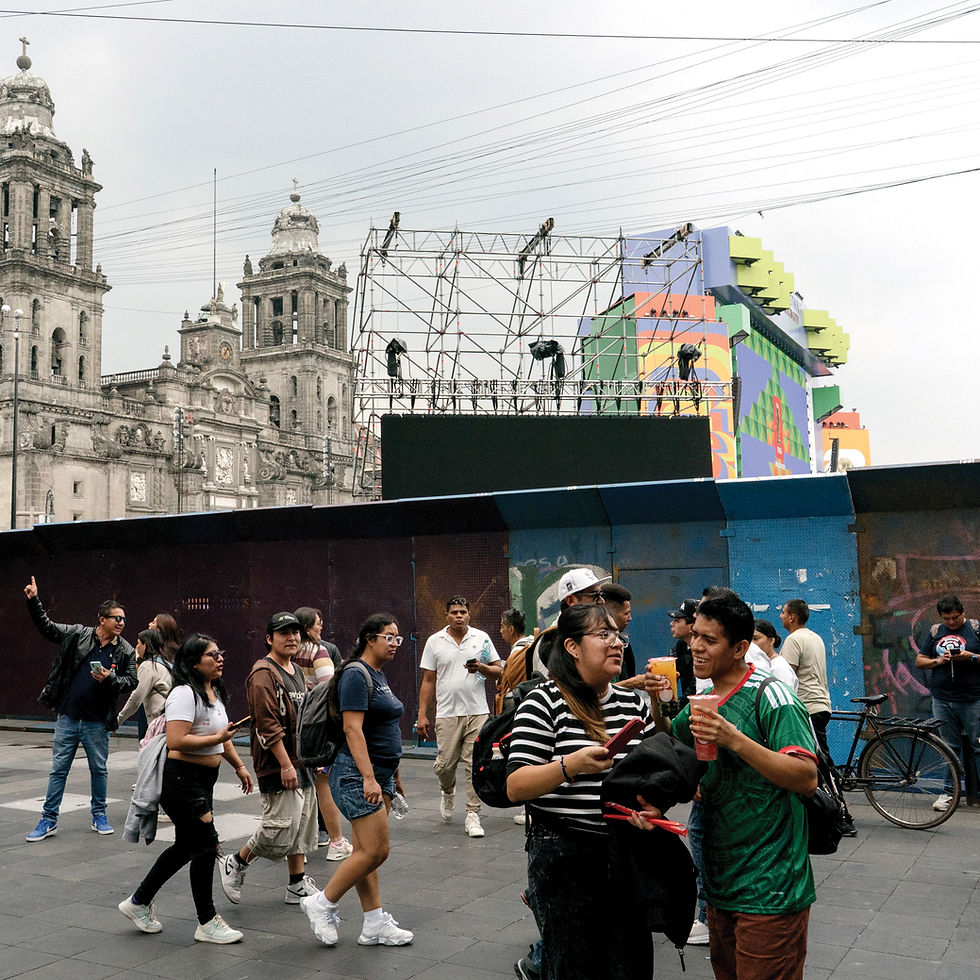
In the heart of Mexico’s capital, plans to host World Cup festivities and screen the opening ceremony to tens of thousands of spectators proceeded, even though the powerful teachers union had shut down much of the area. About 3,000 teachers erected a tent city around the Zócalo, a giant plaza outside the presidential palace in the center of the capital’s normally bustling downtown district.
By 11:30 a.m. local time — an hour and a half before the game started — officials began turning away those waiting to get in, saying the Zócalo’s 80,000-person capacity was full.
Beyond the demonstrations, critics have said the government has not moved quickly enough to prepare for the games and has missed a vital opportunity to rally Mexicans around their flag and stoke national unity. The capital’s airport was still undergoing renovations, while government workers raced to plant flowers across the city and finish painting pedestrian walkways.
The president’s governing party is part of a broader left-wing populist movement that has typically criticized events like the World Cup as catering to the elite, even though all socioeconomic classes enjoy it. Earlier, Sheinbaum announced that she would not attend the games and gave her ticket to a young Indigenous woman who could not afford one.
But the protests are also intended to shine a light on Mexico’s most unfortunate, who say they have been neglected by their government despite promises to help them.
The families of the missing hope to remind the world that more than 130,000 people have disappeared in Mexico, most in the past two decades because of drug cartel violence. They say the government has not lived up to its promises, either in investigating cases or protecting families that are targeted by cartels for drawing attention to their loved ones’ plight.
“I do it for my daughter and the 6,000 missing people in the city and more than 130,000 missing people across the country,” said Vanessa Gámez, who protested this week on the steps of the Angel of Independence, one of Mexico City’s most famous monuments, holding a photo of her daughter, who disappeared nearly a year ago.


