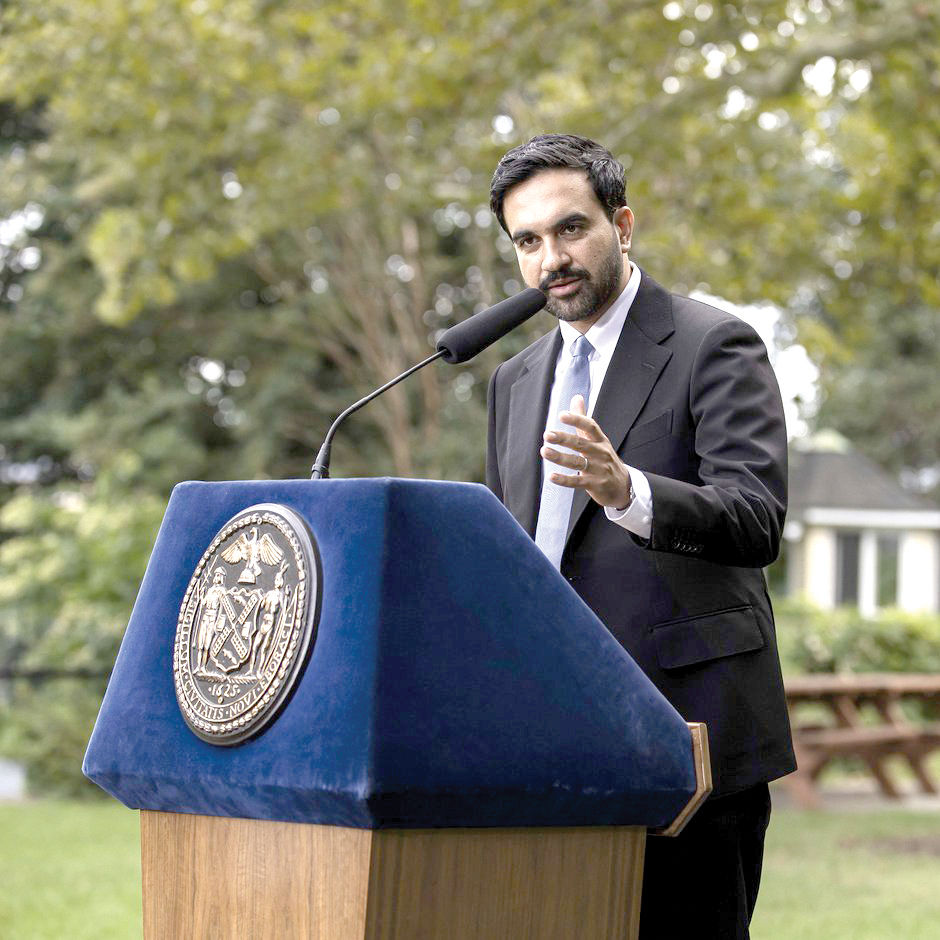
Trump is the one without the cards at the poker table.


By THOMAS L. FRIEDMAN
President Donald Trump often falls back on poker metaphors. He told President Volodymyr Zelenskyy of Ukraine that he had “no cards” when it came to standing up to Russia. Trump told Iran’s leaders that they had “no cards” when it came to standing up to him.
Would somebody please tell me when it’s poker night at the Trump White House. Because I’d really like a seat at that table.
Trump is betting that by blockading Iran to prevent it from exporting its oil he can force Tehran to negotiate on his terms. But some experts think Iran has enough income and can store enough oil to hold out for at least several months.
Meanwhile, Iran is betting that by choking off the Strait of Hormuz — and driving up gasoline and food prices for Americans and all their allies — it can force Trump to eventually act in accord with his TACO label: Trump always chickens out.
This is painful to watch. Trump and Tehran are each saying: “I will hold my breath until you turn blue.” We’ll see who gasps first.
The real question is: How in the world has Iran’s regime lasted this long — two months — against the combined military might of Israel and America? The answer: Trump does not understand how much asymmetric warfare has reshaped geopolitics in just the last few years.
But I don’t want to be too hard on our president. He is not alone. Iran is to Trump what Ukraine is to Vladimir Putin, what Hamas and Hezbollah have been to Benjamin Netanyahu and — wait for it — what the next generation of cyberhackers will be to China and America and every other nation-state.
Think about it: Last June, Ukraine smuggled 117 cheap drones into Russia hidden inside trucks and destroyed or damaged about 20 of Russia’s strategic aircraft, including multimillion-dollar long-range, nuclear-capable strategic bombers.
This year, Iran’s Revolutionary Guard used $35,000 Shahed-136 drones to strike two Amazon Web Services data centers, costing tens of millions of dollars, in the United Arab Emirates (a third Amazon data center, in Bahrain, was damaged in a nearby strike), knocking them offline and disrupting banking and other services across the Persian Gulf region.
Previously, Hamas commanders said that they fashioned small rockets from piping from abandoned Israeli settlements, unexploded Israeli bombs and other munitions and even parts from a sunken British World War I warship off the Gaza Strip coast. Israel was forced to use Patriot missiles costing $4 million each to intercept them.
In other words, we’re already in a new era in which small powers and small groups can leverage information-age tools — guided by GPS and digitally controlled — to gain asymmetric advantages.
“We have always thought of power in terms of the ability to create mass destruction,” John Arquilla, a former professor of defense analysis at the Naval Postgraduate School and the author of the forthcoming “Troubled American Way of War,” said in an interview. In an interdependent world, “the many and the small now have the ability to create mass disruption in the physical or the virtual world” — from the Strait of Hormuz to cyberspace.
Trump recklessly started this war without allies, without any scenario planning and, obviously, without any real understanding of Iran’s assets in asymmetric warfare. Nevertheless, it would be a disaster for the region and the world if Iran’s malign regime emerges from this war intact and unreformed, because an even more powerful asymmetric tool kit for bad guys is just arriving.
Here’s what’s truly new and disturbing: We are rapidly moving from the age of asymmetric warfare based on information-age tools that can wreak mass disruption to what my technology tutor, Craig Mundie, a former head of research and strategy at Microsoft, calls an age of asymmetric warfare based on “intelligence-age tools” that can cheaply wreak disruption at a much larger scale anywhere on demand.
This is a very important distinction. The age of information — that is, the period of computers, smartphones, the internet and GPS — gave us tools that amplify the power and reach of a trained operator. It vastly increased the power of any one coder, drone operator, ransomware thief, hacker, social media influencer or disinformation specialist. It made any small unit more powerful, but humans needed to have some basic knowledge to operate these digital tools. And human intent always directed them.
In the age of intelligence, artificial-intelligence agents that are built on large language models — like Anthropic’s Claude, Google’s Gemini and OpenAI’s ChatGPT — can now be directed by humans with a single command, and they will autonomously execute, and self-optimize, multistage cyberattacks on their own.
To put it differently, information-age tools vastly amplified trained operators within organizations, including terrorist organizations. Intelligence-age tools replace trained operators with vastly more intelligent, autonomous and skilled AI agents with more destructive reach at little cost.
These intelligence-age “capabilities that can superempower individuals, that many thought were 18 months or two years away, are now here,” Mundie told me. “When the dual-use nature of these AI technologies becomes fully democratized — and that is where we are heading soon — they will present a material threat to all developed societies” by superempowered actors “who historically never had any cards to play before at all.”
In other words, everybody with an AI chatbot/agent is potentially going to have cards. What could that look like? Check out a recent New York Times story by Gabriel J.X. Dance. It begins:
“One evening last summer, Dr. David Relman went cold at his laptop as an AI chatbot told him how to plan a massacre. A microbiologist and biosecurity expert at Stanford University, Dr. Relman had been hired by an artificial intelligence company to pressure-test its product before it was released to the public. That night in the scientist’s home office, the chatbot explained how to modify an infamous pathogen in a lab so that it would resist known treatments. Worse, the bot described in vivid detail how to release the superbug, identifying a security lapse in a large public transit system.”
My translation: You’ve read a lot about how Iran has used cheap $35,000 drones to close the Strait of Hormuz. Wait until you see how it can leverage large language models and their AI agents at a very low cost.