


Ukrainian politics has reawakened. Zelenskyy must tread carefully.

By CONSTANT MÉHEUT
For several weeks, with peace talks at a critical moment, Ukraine faced a power vacuum. It had no energy minister amid rolling blackouts caused by Russian strikes. No justice minister as a corruption scandal flared. And no presidential chief of staff to lead negotiations with the United States.
Now, with a flurry of appointments, President Volodymyr Zelenskyy is moving to fill the void, in one of the most consequential reshuffles of the war.
The personnel changes are a sign that Zelenskyy, who used wartime unity to consolidate power, must now be more responsive as Ukrainian politics reawakens nearly four years into Russia’s invasion. How he manages this transition period will hold huge consequences for the country as it fights on multiple fronts, from the battlefield to the negotiating table.
On Friday, Zelenskyy appointed a new chief of staff and said he would replace his defense minister. The next day, he proposed moving the defense minister to the energy ministry. More changes in the government and the military will follow, he said.
The delays in filling the posts had risked allowing the vacancies to harden into government dysfunction, analysts said. Zelenskyy took his time, the analysts said, in part because the corruption scandal, which reached his inner circle and damaged his own standing, has forced him to move more cautiously.
Lawmakers see opportunities in the new political reality. After Zelenskyy governed for years with virtually no opposition, eventually drawing criticism of his top-down approach, members of Parliament may have a chance to emerge from the sidelines.
But the uncertainty has made some of them reluctant to take ministerial posts. In mid-December, David Arakhamia, the head of Zelenskyy’s party faction in Parliament, summed up the moment with dry humor during a conference in Kyiv.
“We are looking for an energy minister,” he told the crowd of participants. “Raise your hands. Who wants to try?”
Adding to the paralysis, the recent acceleration of peace talks has kicked off planning for postwar elections in Ukraine, leaving few people willing to take ministerial positions that might vanish in a matter of months. And rumors of further revelations from the corruption inquiry have had many lawmakers hedging their bets.
“It’s a sort of interregnum,” said Oleksandr Merezhko, the head of the Parliament’s foreign affairs committee and a member of Zelenskyy’s party. “People are waiting to see how things will develop and unfold in each direction before making a decision.”
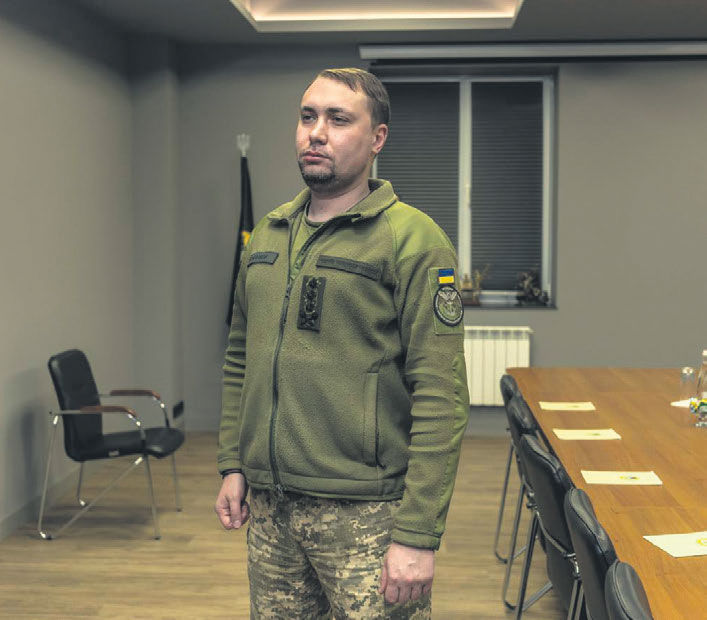
In a reflection of the political machinations gripping Kyiv, the appointment Friday of Kyrylo Budanov, the head of Ukraine’s military intelligence agency, as Zelenskyy’s new chief of staff left many Ukrainians to try to read the political tea leaves.
A highly popular figure, lionized for his daring covert operations in the conflict with Russia, Budanov had long been viewed as a potential rival to Zelenskyy in future presidential elections. Some analysts saw his new appointment as a way for Zelenskyy to clip his wings; others viewed it as a step toward grooming a potential successor.
A more immediate goal might have been to improve Kyiv’s stance in the peace talks with Washington. Budanov, who was trained in a CIA-backed program, has a strong relationship with the United States.
Zelenskyy has also asked Mykhailo Fedorov, a vice prime minister and minister of digital transformation, to become defense minister. Fedorov is one of Zelenskyy’s most trusted lieutenants, having worked with him since his victorious 2019 presidential campaign. On Saturday, Zelenskyy proposed that Denys Shmyhal, the current defense minister and a former prime minister, become the energy minister.
“Overall, Zelenskyy’s team is moving to keep domestic politics firmly under control, seeking to manage the endgame of the war across three fronts simultaneously — defense efforts, the peace track and internal political stability,” Balazs Jarabik, a former European Union diplomat in Kyiv who now works for R.Politik, a political analysis firm, said in a post on the social platform X.
The government vacancies stem from the sweeping scandal revealed in November by Ukraine’s anti-corruption agencies, which found that several officials had siphoned around $100 million in a kickback scheme through the state-owned nuclear power company. Lawmakers called for Zelenskyy to clean house. His powerful chief of staff, Andriy Yermak, and the energy and justice ministers were forced to resign, though none have been formally charged.
The Ukrainian government initially suggested that it would quickly find replacements. The energy minister position seemed particularly urgent to fill, as near-daily Russian attacks on Ukraine’s power grid threatened to plunge much of the country into cold and darkness.
Volodymyr Fesenko, a Ukrainian political analyst, said the reason that Zelenskyy struggled to replace the energy minister was that nobody wanted the job. “All potential candidates for this position — I emphasize, all of them — refused,” he said.
The role scared off people both because of the immense responsibility of managing a power grid under constant Russian attack and the fear of having one’s reputation tarnished by a ministry long plagued by corruption issues, Fesenko said.
Ukraine has not held presidential and parliamentary elections since 2019, when Zelenskyy took office. Martial law, imposed after Russia invaded in early 2022, bans elections during the war. If peace is reached, Ukraine is expected to lift martial law and hold elections quickly.
Zelenskyy hinted Saturday at the difficulty of securing candidates from Parliament. “I have waited quite a long time for proposals from parliamentarians,” he told reporters.
While Zelenskyy has moved to fill the jobs, Parliament — which is scheduled to hold its next plenary session in mid-January — must still approve the appointments. That might prove more challenging than expected.
In recent years, such approvals were largely a formality, as Zelenskyy’s party held a majority through an unusual alliance with former members of a disbanded pro-Russian party. Anatoliy Oktysiuk, a political analyst at KI Insights, a Ukrainian research group, said Zelenskyy had treated Parliament during the war primarily as a body to rubber-stamp laws.
Last month, Ukraine’s anti-corruption agencies accused a group of lawmakers of taking cash in exchange for votes. The lawmakers were not named, but Ukrainian media identified them as belonging to Zelenskyy’s party, Servant of the People.
Lawmakers from Servant of the People acknowledged that they had largely stuck to the party line when voting, though they have not admitted to taking bribes. This summer, for example, they backed a law weakening anti-corruption agencies that had been pushed by Zelenskyy’s office, before reversing course in a second vote after street protests erupted.
The episode eroded trust in Zelenskyy among his own party’s lawmakers, and the recent corruption scandal has prompted some to distance themselves. That could complicate his reshuffling plans, although the two officials proposed for defense minister and energy minister are widely seen as competent by Parliament — a possible signal of compromise.
“We observe that members of Parliament are being taken into account more and more,” Merezhko said. “It’s no longer rubber-stamping.”


