Trump administration pushes narrative of Christian founding at rally.


By ELIZABETH DIAS and RUTH GRAHAM
Thousands of people gathered on the National Mall on Sunday for a daylong rally blending Christian prayer and political fervor, a gathering President Donald Trump had touted as an opportunity to “rededicate America as one nation under God.”
The crowds came to the heart of Washington to hear from spiritual and elected leaders and members of Trump’s Cabinet. Secretary of Defense Pete Hegseth appeared in a recorded video message early in the day, exhorting the crowd to “pray without ceasing,” a phrase that appears in the New Testament.
He recounted an apocryphal account of President George Washington praying at Valley Forge in the winter of 1777-78, a moment that has become a touchstone for some Christians who argue that the founders envisioned America as an explicitly Christian nation.
“Let us pray for our nation on bended knee and let us ask our Lord and savior Jesus Christ, as Washington did on that momentous day, so help us God,” Hegseth said, to cheers from the crowd.
With speeches and Christian music performed against a symbolically potent backdrop at the heart of U.S. government, the rally aimed to crystallize the narrative that the nation’s founding was an intentionally Christian project, a framing disputed by many scholars. The separation of church and state has long been a bedrock principle of American democracy. The First Amendment states that “Congress shall make no law respecting an establishment of religion, or prohibiting the free exercise thereof.”
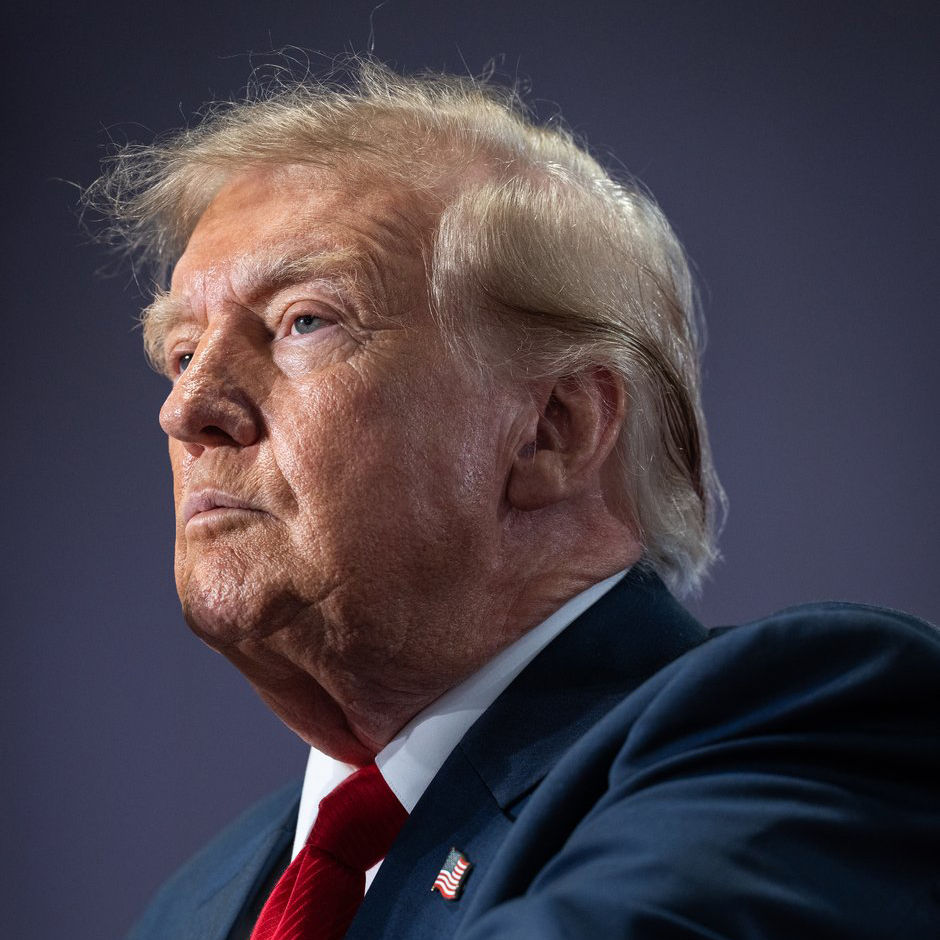
Trump did not appear in person, as some attendees had hoped he would. His participation consisted of a prerecorded video in which he read a chapter from the Old Testament book of 2 Chronicles. The video appeared to be the same one that Trump recorded in the Oval Office last month for a marathon reading of the full Bible organized by an activist in Texas. The passage is a favorite among many of his Christian supporters, who interpret it as a call to national repentance and subsequent blessing.
Vice President JD Vance appeared in a recorded video that played late in the day.
“We’ve always been and still are a nation of prayer, and thank God for that,” he said. In brief remarks that cited George Washington and Charlie Kirk, he celebrated reports of “a wave of young Americans returning to the pews,” and asked for the crowd’s prayers.
Attendees waited in an hourslong line along the Mall between the Washington Monument and the Capitol building to enter as Christian worship music wafted from the stage. Inside the event space, many in the crowd raised their hands in praise, with some waving flags and banners in ecstatic expressions of worship. Some had laid out blankets on the lawn, where they picnicked, read from Bibles and prayed in small groups.
House Speaker Mike Johnson appeared in person toward the end of the program, delivering a long prayer that surveyed decades of American history, describing events from the Civil War to the attacks of 9/11, as moments that showed God’s hand in American history.
“We hereby rededicate the United States of America as one nation under God,” he concluded, to rousing cheers from attendees who had been listening for hours under a hot, almost cloudless sky, with long lines for food and restrooms.
Johnson has argued that separation of church and state is “misunderstood,” and that “the founders wanted to protect the church from an encroaching state, not the other way around.”
The rally, the main religious event of the Trump administration’s 250th anniversary plans, reflected the political success of a right-wing Christian movement that has intensified efforts to end the separation of church and state.
Many of the country’s founders were Christians, and references to religion are present in many of their writings. The role of Christianity in America’s founding is complex, however, and partisans have used historical data points and texts to bolster their political positions for decades.
The idea that the founders saw America as an explicitly Christian nation is “nonsensical” and “dead wrong,” said Joseph Ellis, a Pulitzer Prize-winning historian and author of many books on America’s founding.
Instead, the founders were explicitly pushing back against an assumption that persisted through the Middle Ages, that states needed common religious preference to unite people, he said.
“It is a falsification of the meaning of the American Revolution,” he said.
Conservative Christians have long used educational programs, political activism and reimagined iconography to advance the view that America was founded as a Christian nation. Intensity around this narrative has grown as the share of Christian Americans has declined.
Trump rose to office promising to give Christianity power, and his rallies increasingly fused evangelical worship and political grievance, as right-wing political activity became a kind of holy act for many of his supporters.
In the second Trump administration, Christian worship has become routine inside the White House, and Republican power brokers have infused their public responsibilities with a sense of Christian mission. Hegseth has invoked divine purpose to justify American military power, and prayed to “King Jesus” at a White House dinner.
The prayer event showed that the separation of church and state was “under extreme attack,” said Rachel Laser, president of Americans United for Separation of Church and State, which has filed seven lawsuits against the administration related to its turn toward Christianity.
“If Trump really wanted to celebrate what is unique and foundational about America, he’d be celebrating our promise of church-state separation and religious freedom for all,” she said.
American adults largely do not want Christianity to be the country’s official religion, but over the past two years, the portion who do want it to be has increased from 13% to 17%, according to a recent survey from the Pew Research Center.
Several attendees said that the last time they had been in Washington was to participate in the election protest on Jan. 6, 2021, that turned into an attack on the Capitol building.
“To be back here for this is a redemption,” said Lynna Zapata, a pastor in west Texas, who added that she was not among those who breached the building. “And it’s us seeing the fruit of what we prayed for five years ago.”
Zapata said her experience on Jan. 6 became “traumatic” because of the disjunction between her positive experience and media reports on the attack.
There are things that still need to change in the country, Zapata said. But being back in the heart of Washington, surrounded by people praying and singing along to Christian music with the blessing of the president, she said, was a sign that things were moving in the right direction.