


International scientists promote protection of nature’s rights in Puerto Rico & the Caribbean
- The San Juan Daily Star

- Dec 26, 2025
- 4 min read
By THE STAR STAFF
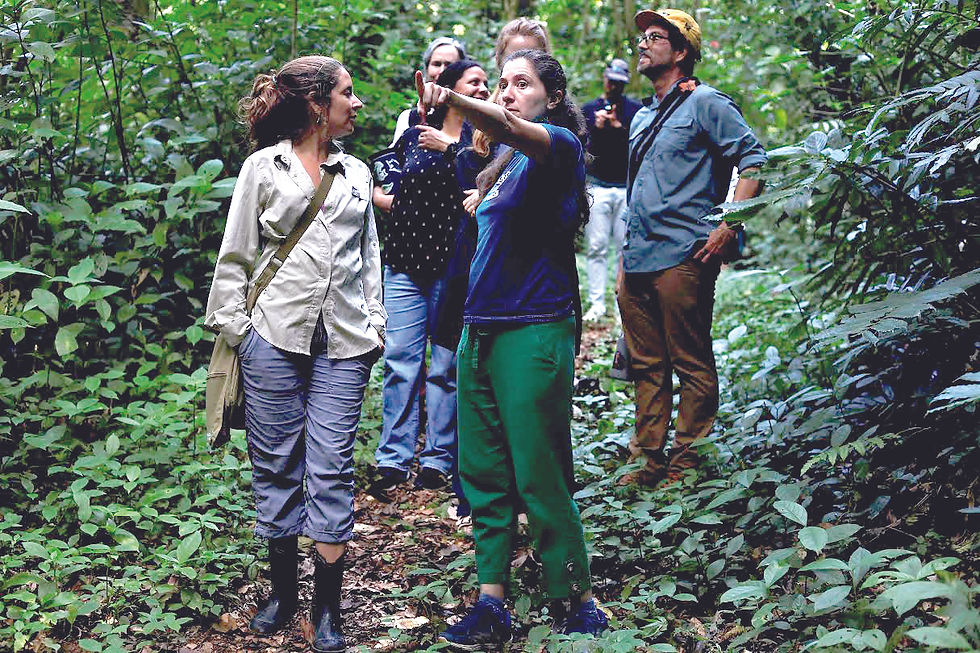
Caribbean scientists are warning about the urgent need to legislate in Puerto Rico and the Caribbean to protect the rights of nature, as has already happened in 40 countries that have achieved important legal victories for endangered animal species, preservation of natural habitats and the defense of the planet.
“It is up to us in Puerto Rico to look toward the Caribbean, protect endangered species, and promote legislation for endemic species. In Belgium, they have just enshrined ecocide against nature into law,” said professor and ecologist Dimaris Acosta during a discussion at the University of Puerto Rico, Mayagüez Campus (RUM by its acronym in Spanish) earlier this week. “They created an embassy to protect endangered fish in the Baltic Sea. It is up to us in the Caribbean to be better ancestors for future generations and sow the seeds of protecting the rights of nature. We may not see the effects of having a better, more sustainable planet, but our descendants will.”
The concept of the rights of nature -- the subject of an international scientific gathering at RUM sponsored by the Puerto Rican Coalition for the Inherent Rights of Nature, the Segarra Boerman Foundation, and Para La Naturaleza -- posits that nature has its own existence and is not subject to human control. It is also linked to human rights and well-being because, to survive, human beings depend on a healthy ecosystem. In countries where those rights are enshrined in law, any citizen has the legal capacity to represent nature in court.
“A frog beat the Ecuadorian minister,” said Andrea Terán, a biologist from Ecuador participating in the forum. “The long-nosed harlequin frog was endemic to Ecuador and disappeared in the 1980s. A few years ago, in the Intag Valley, in the Andes region, the frog was found in the middle of a mining concession. The company had failed to disclose that this was the last and only population of the long-nosed harlequin frog. It was later discovered that they had also omitted other species. After several legal battles, the frog was finally able to have its voice heard, and the company’s license was revoked for ignoring these species present in the mining operation.”
In the case of Panama, American marine biologist Callie Veelenturf played a key role.
“I was a proponent of the Rights of Nature in Panama. My involvement stemmed from the turtles and their nesting grounds, something that concerned me,” Veelenturf said, highlighting the achievements of the protected turtle nesting areas and a wildlife refuge in Panama in 2024. “I consulted books like David Boud’s ‘The Rights of Nature,’ which proposes a legal revolution to change the world. In Panama, this was achieved in two years. I met with Congressman Juan Diego Vásquez, who introduced the legislation in 2022. Now, any citizen can bring a case in defense of nature.”
Participants in the discussion included Monique Johnson, geoscientist (Trinidad and Tobago/Bahamas); Dimaris Acosta, microbial ecologist (Puerto Rico); Machel Donegan, geographer (Jamaica); Eladio Fernández, conservation photographer (Dominican Republic); Juan Pablo Álvarez Rosario, phycologist (Puerto Rico); Carlos Torres, ecologist (Puerto Rico); Callie Veelenturf, marine conservation biologist (USA/Panama); Andrea Terán, biologist (Ecuador); Steve Maldonado Silvestrini, artist and botanist (Puerto Rico); and Jaime Suárez Berrocal, artist (Puerto Rico). The dialogue was facilitated by Alexandra Hertell, from the Segarra Boerman Foundation, and Camila Marambio, from Para la Naturaleza.
Álvarez Rosario noted that “we can protect the rights of nature.”
“Whether through a community movement, at the municipal or watershed level, or at the state level, one thing that can happen is to promote a Caribbean union to take the fight for the rights of nature to another level,” the environmental scientist said.
He added that in Puerto Rico, environmental organizations such as ISER Caribe and Cirom-PR, in dialogue with a fishing community, support the ecological restoration of coral reefs on Isla Magueyes in Lajas, using corals cultivated in nurseries, as well as the entire ecosystem surrounding the reefs. Such ecosystem restoration is achieved by reintroducing species such as sea urchins, crabs and microalgae. In this way, the marine habitat is improved and coastal erosion is reduced.
The discussion included the participation of professionals from other disciplines, such as Dominican photographer Eladio Fernández, who documents environmental crimes with his photographs, stories that have had an impact and led to changes in public policy. Among them, he mentioned photos of eel fishing, a lucrative business in the Dominican Republic that could endanger the species.
Another of Fernández’s photographic achievements was denouncing the mistreatment of flamingos, whose wings were clipped for display in hotels and tourist resorts. Following his denunciation, the flamingos have been removed from all the hotels and are now in a protected area.
The coalition plans to continue public education on the topic in Puerto Rico and eventually promote legislation. Its commitments are outlined in the Declaration of Recognition and Defense of the Inherent Rights of Nature. Spokespeople noted that those who agree with this declaration can join the coalition (linktr.ee/derechosdelanaturaleza).


This report was both reassuring and informative, and the way you presented the facts helped clarify a situation many people are concerned about. The tone struck the right balance between urgency and calm. I recently read a similar public-interest update mentioned on https://thepurpleshopcannabis.com which also emphasized community stability. Strong and responsible reporting.
We appreciate the dedication to sea turtle conservation that Veelenturf has shared. To improve the content, please make the monitoring reports of the reserve more transparent. Making knowledge easily accessible plays a huge role in building trust; this also explains the appeal of Unblocked Games, as it ensures that all users can find the content they need smoothly.