


Puerto Ricans in NY-NJ metro area have higher cost of living compared to island
- The San Juan Daily Star

- Dec 4, 2025
- 3 min read
For those living in Central Florida, it’s lower
By THE STAR STAFF
Puerto Ricans living in the New York and in the Newark and Jersey City, New Jersey areas, who left the U.S. territory seeking a better quality of life, are facing a cost of living that is nearly 41% higher than in Caguas, San Juan or Bayamón.
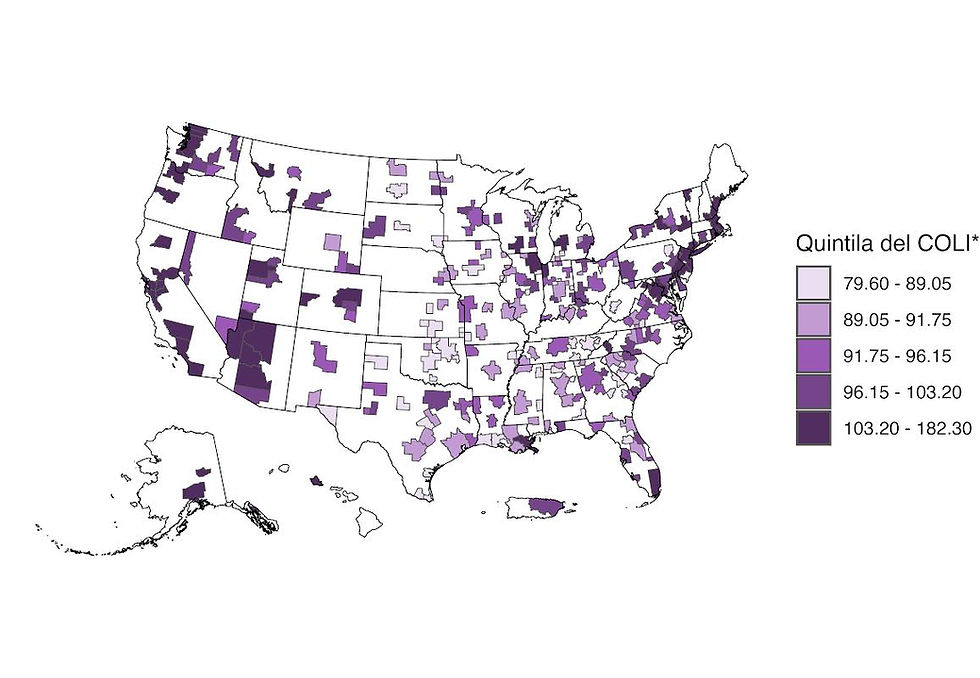
The Puerto Rico Institute of Statistics (PRIS) recently presented an analysis that integrates information from the Cost of Living Index (COLI) and demographic data from the U.S. Census Bureau. The analysis enables a simultaneous observation of the cost of living in U.S. metropolitan areas and the distribution of people who identify as Puerto Rican in those regions.
The analysis reveals a key finding: a significant portion of this population resides in urban areas where the cost of living is higher than in Puerto Rico, particularly in some of the most expensive jurisdictions in the country. For instance, the New York-Newark-Jersey City area has a cost of living that exceeds that of the San Juan-Bayamón-Caguas Metropolitan Statistical Area (MSA) by over 40%. An MSA is defined as an urban geographic area with a population of at least 50,000 inhabitants and adjacent areas connected by socioeconomic ties.
Data presented in map form in the analysis shows that among the top 10 MSAs with the largest numbers of people identified as Puerto Rican, five have higher cost-of-living indices than the San Juan-Bayamón-Caguas MSA.
The New York-Newark-Jersey City Metro area has the highest number of people who identify as Puerto Rican, followed by the Orlando-Kissimmee-Sanford Metro area. Specifically, the cost of living index in the New York-Newark-Jersey City area is 40.9% higher than that of the San Juan-Bayamón-Caguas area, whereas the Orlando-Kissimmee-Sanford area has a cost of living index that is 10.3% lower.
The cost of living data was collected during the third quarter of 2025 in the San Juan-Bayamón-Caguas area, as also indicated in the map.
The index is based on a value of 100, meaning that a value above 100 indicates a higher cost of living, while a value below 100 indicates a lower cost of living. Additionally, a ranking is calculated that allows for comparison of each MSA’s position against the participating jurisdictions. A lower rank indicates a higher cost of living, and vice versa.
In the third quarter of 2025, the San Juan-Bayamón-Caguas MSA had a cost of living that was 2.2% higher than the average of the 290 participating urban areas. Public services (utilities) were found to be 60.4% more expensive than the average of participating urban areas, ranking 7th in cost. Another category with a higher than average cost is supermarket items, which were ranked 17th and were 9.5% above the average of participating areas.
To further enhance the comparative analysis by MSA, the Institute examined the number of people identified as Puerto Rican residents in the 290 urban areas involved in the cost of living study. Data on individuals identified as Puerto Rican was obtained from the five-year estimates (2019–2023) of the American Community Survey conducted by the U.S. Census Bureau.
Despite the varying costs of living in the top 10 MSAs with significant Puerto Rican populations, the San Juan-Bayamón-Caguas MSA remains more expensive for utilities than any of the top 10 MSAs. In terms of grocery costs, it is more expensive than nine of these areas. Conversely, it is more affordable in the transportation, miscellaneous, and healthcare categories. For housing, six of the 10 MSAs have higher cost indices than the San Juan-Bayamón-Caguas MSA.
“The cost of living is one of the most important economic issues for Puerto Rican society, as it affects the availability of household resources and the sustainability of their consumption patterns,” noted Dr. Ronald G. Hernández Maldonado, statistical project manager in economics at the PRIS. “The integration of demographic and economic analyses strengthens our ability to more accurately assess the economic conditions of Puerto Rican households and generate solid empirical evidence on the contemporary challenges they face in various metropolitan areas.”
Lanselotte Oliveras Vega, statistical project assistant in demography and geography at the PRIS, added: “Of the people who identify as Puerto Rican in the United States, 5,869,928 reside in a metropolitan area. Four out of five live in a Metropolitan Area of Saturation (MSA) that is included in the COLI study. The two metropolitan areas with the largest Puerto Rican populations are New York–Newark–Jersey City and Orlando–Kissimmee–Sanford; the former attracts a significant portion of the initial wave of migration, while the latter reflects more recent migrations. The data suggest that New York–Newark–Jersey City is becoming less central as a residential area for the Puerto Rican population, potentially due to its high cost of living.”


This makes a lot of sense. The NY‑NJ metro is expensive for everyone, and when you compare it to life on the island, the gap really shows up in everyday costs like housing, groceries, and transportation.
A few folks I know from PR who moved up here have mentioned the same thing: they expected some price difference, but the scale of it still hits hard once you start doing the math. Even something like switching phone plans feels different. I was just reading Cell Pay Us reviews the other day, trying to find a better deal, and the cost differences between carriers up here versus what people pay back home were eye‑opening.
It’s a real challenge for families juggling work,…