


Ukrainian Olympian is disqualified over helmet honoring war dead

By HEATHER KNIGHT, TARIQ PANJA and VICTOR MATHER
A Ukrainian athlete was disqualified from the Winter Olympics on Thursday over his plans to wear a helmet honoring countrymen killed in the war with Russia, a decision that drew outrage and touched off the biggest crisis of the Games in Italy.
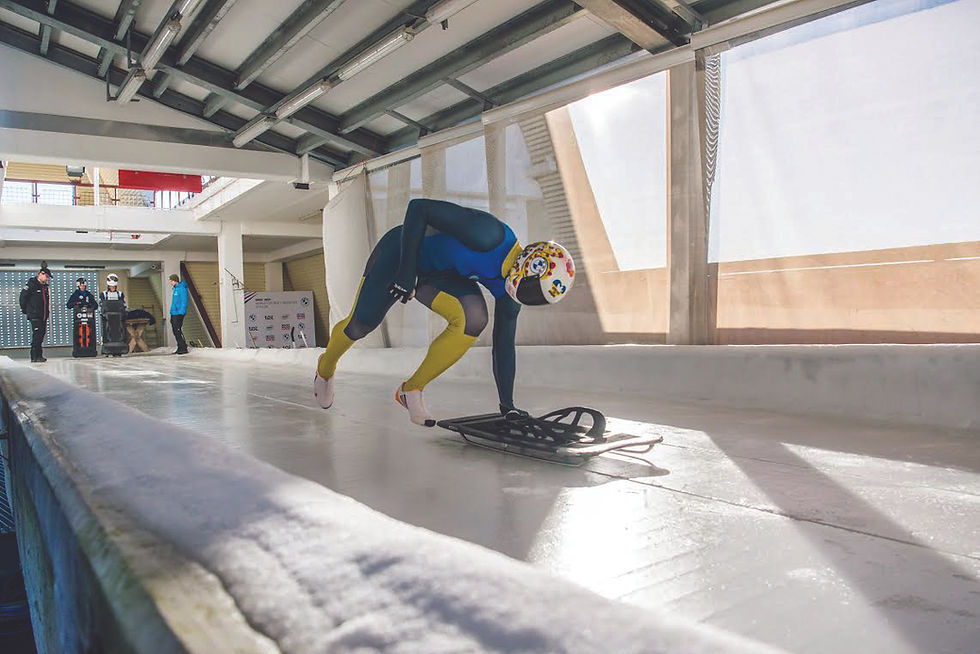
Olympic officials had told the athlete, Vladyslav Heraskevych, that the helmet violated the Games’ prohibition on political speech. Heraskevych, who competes in skeleton, a sledding event on an ice track, had said this week that he planned to race with it anyway.
Moments before the competition Thursday morning, Heraskevych held talks at the track in Cortina d’Ampezzo with the president of the International Olympic Committee, Kirsty Coventry. The meeting ended with Heraskevych barred from competing and Coventry and the athlete’s father both in tears following a failure to reach a compromise.
“I felt that it was really important to come and talk to him face to face,” Coventry, who is presiding over her first Olympic Games, told reporters after the meeting.
Coventry’s direct and personal intervention underscored the stakes of a dispute that reverberated from Cortina to Milan, where the IOC leadership is based during the Games, and all the way to Ukraine, where President Volodymyr Zelenskyy praised Heraskevych’s courage and denounced Olympic officials for playing “into the hands of aggressors.”
“His helmet, bearing the portraits of fallen Ukrainian athletes, is about honor and remembrance,” Zelenskyy wrote in a social media post. “It is a reminder to the whole world of what Russian aggression is and the cost of fighting for independence.”
Speaking to reporters in Cortina, Heraskevych insisted that he had not broken any rules.
“There are things more important than medals,” he said. “I stood up for what I believe in.”
The IOC said that it had no choice but to disqualify Heraskevych in order to preserve what its chief spokesperson, Mark Adams, described as “the sanctity of the field of play.” In the view of Olympic officials, the athlete’s helmet, featuring portraits of 21 Ukrainian athletes killed in Russian attacks, violated a prohibition against political messages during competitions.
In 2020, Olympic officials loosened the rules to allow athletes to make statements during the Games on social media or to journalists, but not while competing or on the medal stand. Heraskevych had worn what he called his “remembrance helmet” during practice runs this week, but a clash had loomed for days over his use of it in the competition.
Adams said at a daily news conference Thursday that the IOC had offered concessions to Heraskevych, including allowing him to wear a black armband to honor the fallen athletes and permitting him to bring his helmet into a post-race media zone. The athlete refused those offers.
Adams said the IOC’s rules must remain in place for the Games not to descend into “chaos,” given other conflicts around the world.
“If everyone wanted to express themselves in that way beyond a black armband, it would create a field of play which becomes a field of expression,” he said.
Although the IOC has portrayed the war in Ukraine as one of many conflicts, Russia’s Olympic committee is the only one formally suspended from Olympic competition. That ban came into effect in 2022 after the Russian committee absorbed official sporting bodies in four occupied regions of Ukraine.
The IOC said that Heraskevych would be allowed to remain at the Olympics, even though he is no longer eligible to compete.
The skeleton competition proceeded Thursday, but Heraskevych’s disqualification loomed over the event.
Ivo Steinbergs, the coach of the Latvian team, prepared a protest letter and was encouraging other teams to sign it. The letter demands Heraskevych’s reinstatement and a clearer distinction from the IOC between a memorial tribute and political advocacy.
Steinbergs said it was crushing to have seen Coventry and other officials call Heraskevych into a meeting before the first heat of the competition Thursday morning, then to see him emerge with a disqualification letter and his father next to him in tears.
“And that was the end of his Olympics,” Steinbergs said. “He was going for this for 12 years, and they just stole it from him.”
Tom Johansen, the coach of the Danish skeleton team, said it was unfair to expect an athlete from Ukraine to put the war out of his mind at the Olympics and “just act like a robot.”
His son, Rasmus Vestergaard Johansen, a racer who called Heraskevych a friend, said: “He is representing young people who died way too early, and I don’t think any athlete, any people, should go through what Ukraine and what Vlad have gone through.”
Ukrainian officials and other athletes have expressed support for Heraskevych. On Tuesday, Olena Smaha, a Ukrainian who competes in luge, wore a message on her glove during her competition that said: “Remembrance is not a violation.”
Before being elected to lead the IOC last year, Coventry, a Zimbabwean who is a two-time gold medalist in swimming, had been part of a group of athletes that helped the organization create its current rules on athlete expression.
In her first year as president of the organization, the IOC has tried to draw a firm distinction between sports and politics, with Coventry insisting that sports must be a “neutral ground.”
But in Italy, the IOC has faced questions over the presence of some Russian athletes at the Games, competing under “neutral” status. And on the day of the opening ceremonies last week, a protest broke out in Milan over the presence of U.S. Immigration and Customs Enforcement personnel on a State Department security team for the Games.
Fans who gathered to watch the first two heats of the skeleton Thursday lamented that Heraskevych had been disqualified.
“It’s not political. It’s a tribute to his friends,” said Paolo Dallago, who lives in Cortina. “It’s remembering that there’s still a war, and a lot of people are dying.”


